



Why Airports Slow Down (Even When It’s Not a Blizzard) We’ve all seen it: your flight is “on time”…...
Have your agent call us
“Am I actually going to make this connection?”
For a long time, answering that question required deep expertise in delay patterns, airport operations, and probabilistic modeling.
Now it doesn’t. With Lumo’s MCP server, any itinerary management or booking tool can turn a static itinerary into decision-grade insight—and even suggest better options.
A "simple" test
We pointed Postman's MCP explorer tool ay our MCP server and started with a simple question:
"I'm flying the following flights on Apr29th
AA 2902 — El Paso → Dallas
AA 3309 — Dallas → McAllen
How likely am I to misconnect?"
Lumo returned:
✨ Misconnection probability: 37.23% (HIGH RISK)
Delay index: 7.7
Nearly 49% of outcomes fall into extreme delays (240+ min or cancellations)
Then, we asked:
"What about the same itinerary on Apr 28th?"
✨ Misconnection probability: 21.65% (HIGH RISK)
Delay index: 6.5
Extreme delay risk drops to 27.8%
Same flights. Same airport. Same connection time, but nearly 2× difference in risk depending on the day.
So far, there's nothing here that couldn't have been done by just hitting the Lumo API and getting our predictions. Here'e where the magic of AI comes in. We then asked
"Why does Lumo think I will miss my connection tomorrow?"
This isn't asking just for stats - it's asking for expertise.
Here’s what the LLM surfaced with Lumo's help:
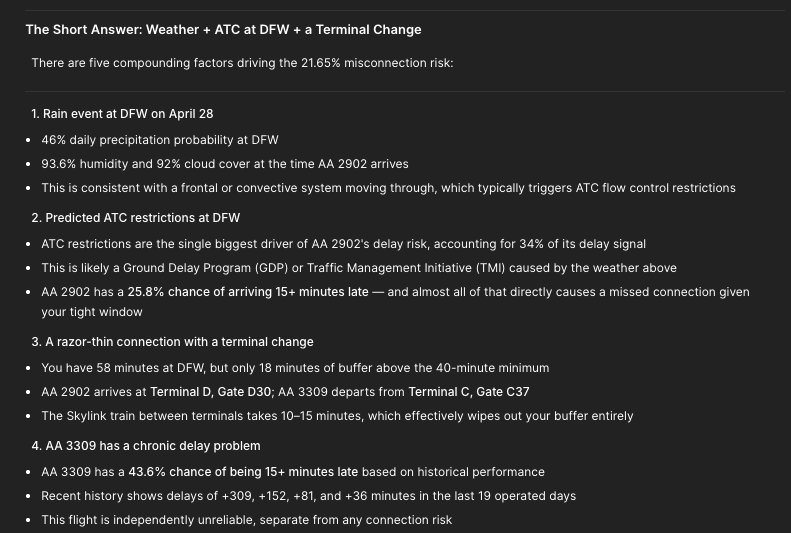
This isn’t just data—it’s causality. You can see exactly how weather leads to ATC restrictions, which delays the inbound aircraft, which interacts with a tight connection and a terminal transfer to create real misconnection risk.
This is the kind of reasoning that used to require a domain expert.
And then it suggested a better option
Lumo didn’t stop at diagnosis, it then suggested an alternative.

What’s actually new here: from data to decisions
None of this is new at the data layer. We’ve had APIs for years that expose delay probabilities, risk signals, and operational data. But there was a problem: Developers had to know what to ask—and how to interpret the answer.
Turning raw delay signals into something actionable required the ability to take Lumo's data and then translate this into something meaningful.
The MCP server changes how this gets used.Instead of stitching together multiple endpoints and building your own interpretation layer, tools can now pass an itinerary, ask natural questions, and get back insights, explanation, and recommendations.
The shift here isn’t “we added AI.” It’s this: We moved from exposing data to delivering decisions.
🚀 Ready to learn more?