

Why Airports Slow Down (Even When It’s Not a Blizzard) We’ve all seen it: your flight is “on time”…...
Airline operations teams are expected to stay ahead of disruptions before they affect the network. But doing that requires monitoring a large and constantly changing set of signals: weather forecasts, airport conditions, air traffic management initiatives, capacity constraints, flight schedules, and the ways those factors may interact across the network.That research can consume hours of work every day, often before an operations team can begin making decisions.
Today, we’re introducing the first customer-facing agent within Lumo Ops Manager: an always-on airline operations intelligence agent designed to help airline operations managers and System Operations Center (SOC) teams identify where to focus their attention.
This is AI in practice—not AI for its own sake.The agent continuously scans Lumo’s disruption predictions, global delay conditions, weather, airport capacity signals, and, within the United States, FAA advisories and Traffic Management Initiatives (TMIs). It then coordinates multiple layers of analysis to produce a validated, airline operations analyst-style report.
The result is a prioritized view of what may matter over the next 14 days.
From scattered signals to an operational outlook
The agent is designed to answer practical questions for airline operations teams:
-
Which airports are most likely to experience disruption?
-
When are the highest-risk periods expected?
-
Is the risk driven by weather, airport capacity, an FAA initiative, or a combination of factors?
-
Which events could create network-level consequences?
-
Where should the operations team investigate first?
A typical report provides a systemwide outlook alongside airport-specific findings. It can identify expected delay and on-time-performance impacts, potential capacity reductions, affected operating windows, TMI probabilities, arrival-rate scenarios, and likely operational consequences.
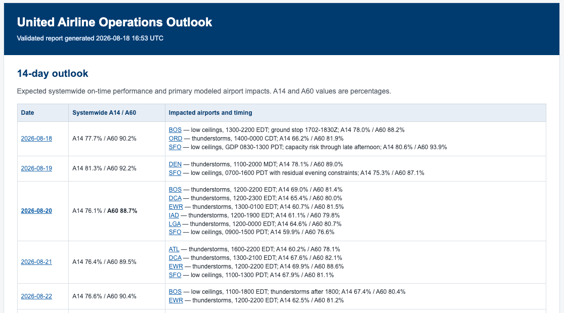
For example, a recent 14-day outlook identified a combination of low ceilings, thunderstorms, ground-stop exposure, and arrival-capacity constraints affecting airports including Boston, Chicago, San Francisco, Denver, Washington, Newark, and New York LaGuardia.
The report did more than list possible weather events. It connected those conditions to operational implications—including holding, missed connections, diversions, gate compression, crew and aircraft displacement, and next-day recovery risk. (Click on the image to view the report).
A coordinated team of operational agents
The technology behind the report is a coordinated team of specialized agents.
A triage agent first scans the network and identifies the signals most likely to matter. It determines which airports, dates, and events require deeper investigation.
Airport specialist agents then analyze individual locations. They combine local weather, delay predictions, airport capacity scenarios, flight activity, and relevant air traffic advisories to build a more complete picture of each potential disruption.
An expert agent reviews and synthesizes those findings into a coherent operations report. It checks the evidence, compares signals from different sources, identifies inconsistencies, and translates technical data into operational implications.
This is where the system becomes more than a collection of automated summaries. The agents divide the work, pass findings between one another, and create a reviewable chain from raw signal to operational conclusion.
The result is a system that can perform many hours of structured research in a few minutes.
Delivering the right information to the right person
The agent is also designed to adapt how it communicates.
A network operations manager may need a systemwide view of emerging hotspots. A station operations leader may care primarily about specific airports and operating windows. A planning or recovery team may need more detail about capacity scenarios and downstream effects.
Lumo can send updates directly to individuals and tailor the message to the recipient’s role. The underlying operational picture remains consistent, but the emphasis, level of detail, and recommended areas of attention can change based on who is receiving it.
This turns the agent from a passive dashboard feature into an active operational support layer—one that can monitor conditions, prepare analysis, and proactively bring relevant information to the people who need it.
Built to support operations teams... not replace them
The goal is not to replace airline operations professionals.
Airline SOC teams bring experience, judgment, context, and decision-making skills that cannot be reduced to a forecast or report. Their time is best spent evaluating tradeoffs, coordinating with stakeholders, managing irregular operations, and deciding how the airline should respond.
The agent is designed to help them get to that work faster.
Instead of spending hours searching across forecasts, advisories, airport conditions, and operational data, teams can begin with a prioritized view of the network. The agent points them toward the airports and time windows that deserve attention, so experienced operators can investigate, validate, and act.
Disruptions do not follow business hours. Lumo’s airline operations agent is designed to operate 24 hours a day, 7 days a week, 365 days a year—continuously watching for emerging risks and keeping the outlook current.
What comes next
This first agent establishes the foundation for a broader set of operational capabilities within Lumo Ops Manager.
Planned future agents include capabilities for:
-
Identifying crew timeout and legality risks
-
Detecting passenger misconnect exposure
-
Suggesting alternative passenger routings
-
Connecting disruption forecasts to aircraft, crew, and passenger recovery decisions
Together, these agents will help airline operations teams move from identifying disruption risk to evaluating the operational consequences and potential responses.
The first step is giving teams a clearer view of what is coming—and giving them that information before disruption becomes the day’s emergency.
Interested in learning more?