


If you’ve ever worked in corporate travel, you know that airline waivers are both a blessing and a...
Airline travel waivers are supposed to make disruption easier to manage.
When severe weather, natural disasters, or other major events threaten an operation, a waiver gives travelers and agencies flexibility. They may be able to change flights, avoid a disruption, or move travel to a safer time without paying change fees.
That is useful. But something else is happening: waivers are becoming more frequent, broader, and harder for travelers to base decisions on.
In our own monitoring data, we found 540 waiver records tied to January–August 2026 travel dates across 16 carriers represented in the data. The volume is not evenly distributed, and it is not limited to major weather events or widespread operational failures.Increasingly, airlines are issuing waivers for narrower disruptions, including localized thunderstorms and regional weather systems.
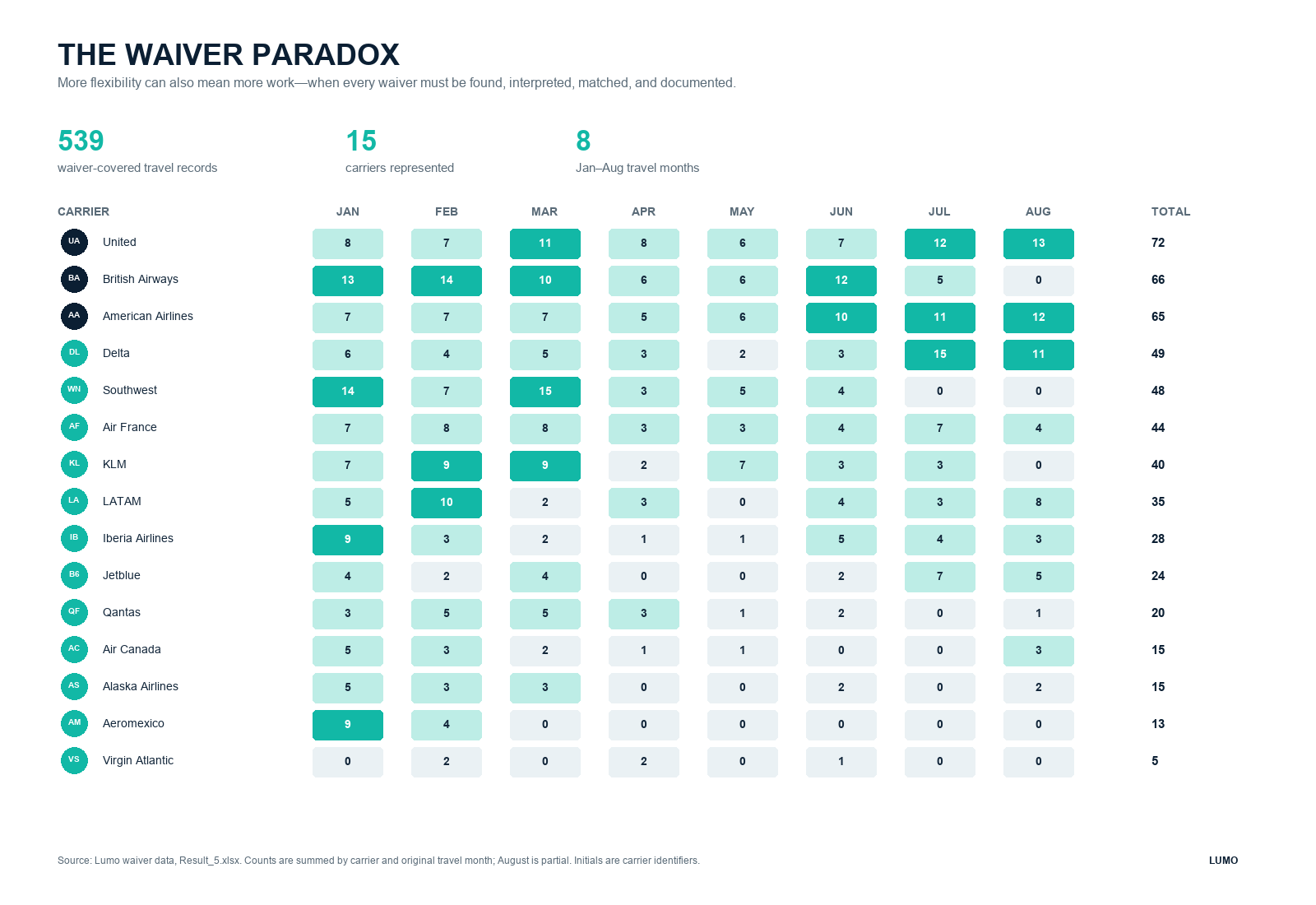
Not all of these waivers were issued for the same reasons. Some were tied to geopolitical events in the Middle East. But those were the exception. The overwhelming majority reflected more familiar causes: weather, airport conditions, and localized operational disruptions. That is what makes the trend especially notable. Waivers are no longer reserved only for extraordinary, large-scale events; they are increasingly being issued for narrower and more localized risks.
For example, both Delta and American recently issued broad waivers covering Chicago O’Hare for a day when evening weather was expected, even though the likelihood and severity of disruption varied considerably by flight and time of day. That creates a problem for everyone involved.
A waiver can be helpful, and still create confusion
I experienced this firsthand after the GBTA Annual Convention in Chicago on August 5. Many of us were returning home that day. Weather was expected in Chicago later in the evening, and both United and American issued waivers covering O’Hare for the entire day. As the person who is often asked about flight disruption, I started getting questions:
Should I move my flight? Is my morning departure at risk? Should I take the waiver now, while I can?
The questions were completely reasonable. The existence of a waiver suggested that changing flights might be the prudent thing to do. But the actual situation was more nuanced. Morning flights were unlikely to be meaningfully affected. Evening flights faced some risk, but not every flight was going to experience the same level of disruption. The waiver did not communicate that nuance. It communicated flexibility across a broad window.
That may have led some travelers to make unnecessary changes. It also created work for travel agents and corporate travel teams, who had to interpret the waiver, determine whether it applied to a specific itinerary, and document the exchange correctly using the appropriate waiver code. It likely created additional work for the airlines as well, through calls and change requests from travelers whose flights may ultimately have operated without significant disruption.
This is the waiver paradox: The tool designed to reduce disruption can create another layer of disruption when it is too broad or too difficult to interpret.
Waivers are becoming a full-time information problem
For agencies and TMCs, monitoring waivers is no longer a simple exception-handling task. A team may need to:
-
Monitor multiple airline portals and distribution channels
-
Track new waivers and updates to existing waivers
-
Understand the affected airports, dates, and flight windows
-
Determine which travelers have tickets that qualify
-
Apply the correct waiver code and documentation
-
Communicate the options clearly to the traveler
-
Keep records of what was changed and why
That is a considerable amount of work, particularly when several airlines issue overlapping waivers for the same weather system.
The challenge is not only finding the waiver. It is understanding what the waiver means in the context of a specific trip.
A traveler flying from Chicago at 7 a.m. is not facing the same risk as a traveler departing at 8 p.m. A nonstop flight is not the same as a connecting itinerary. A waiver that covers an entire airport and day may be operationally convenient to publish, but it does not necessarily reflect the risk faced by every traveler.
The next step should be more targeted waivers
Several airlines already issue waivers for specific flights or narrowly defined travel dates. That suggests a more precise model is possible.
What if airlines could identify the specific flights, routes, or time windows most likely to be affected and issue waivers accordingly?
Instead of: "All flights departing Chicago O’Hare on August 5", the policy might be closer to: "Flights departing Chicago O’Hare between 5 p.m. and 10 p.m. on August 5".
That kind of precision would not eliminate uncertainty. Weather and airline operations are too complex for that. But it could reduce unnecessary changes and make the waiver more useful to the people who need it.
The architecture for this already exists. Airlines and travel companies have access to increasingly detailed operational data, including weather, airport conditions, traffic flow, capacity constraints, and historical disruption patterns. The challenge is bringing those signals together early enough to support a decision.
The goal is not to discourage airlines from issuing waivers. Waivers can be extremely valuable, especially when there is a genuine risk of widespread disruption.
The question is whether the industry can make them more targeted, more contextual, and easier to act on.
Because flexibility only helps when people understand when to use it.
I would be interested to hear from airline operations, revenue-management, customer-service, and distribution teams: Are broader and more frequent waivers reducing disruption—or are they sometimes moving the work somewhere else?